Showing posts with label #MeridianMAI. Show all posts

Tuesday, June 7, 2016

The US's Pollution Levels are at an Unhealthy Rate Among More Than Half of the States

Photo Credit: Huffington Post

The majority of the world knows that the air around them is unclean, but do they know just how contaminated it really is? The air within the United States is full of pollution. A few weeks ago, the American Lung Association revealed that the US population is living among extremely unhealthy air. 

Pollution can be visible or virtually invisible to the human eye. The most well-known type of pollution is smog; a visible pollutant. Smog can be see all around the world, especially in well-developed, industrial areas. It is created when the gases that come out of tailpipes, smokestacks and other sources come into contact with sunlight. 

Pollution is dangerous in any form. Breathing in the contaminated air can result in early death, cardiovascular harm, respiratory disease and cancer. The catastrophic damage that results from the pollution has not stopped people from building up areas and creating more objects that produce harmful particles. Even with all of this information open to the public and plainly stated, nearly 20 million people are living among these harmful pollutants in the United States alone. A report from 2015 showed that 4 in 10 Americans are living in areas with unhealthy levels of pollution. Measures must be taken to protect the air we breathe. Unclean air not only causes us harm, but it is also extremely harmful to our ecosystem. 

Read more about the current state of pollution - Huffington Post

Wednesday, April 27, 2016

The Life Expectancy of an Electric Vehicle

Image Credit: Chevy Volt
     One of the main factors that causes people to shy away from the idea of an electric vehicle (EV) is its life expectancy. The fear is not because the battery life is necessarily short, but is due to the fact that there is not much data supporting either side since they are a relatively new commodity. Reliability and durability are two extremely important factors when car shopping, and they can make or break your decision. The lack of information is enough to make this an unsettling option, however the information that is currently available makes EVs appear to be a pretty safe bet.

     Eric Belmer, an EV owner, drives his Chevy Volt long distances daily; his monthly work commute adds up to 6,500 miles. His 2012 vehicle has just reached 300,000 miles and is still going strong on its first battery. This news means that electric vehicles, at least the Chevy Volt, are a reliable choice. More in-depth research has found that many EVs have 100,000 miles on them or more, and they are still using their original battery. More data allows the buyer to have peace of mind as their concerns are addressed.

     If you want to purchase an electric car, the reliability and durability of the vehicle are factors that can be put in the back of your head and no longer serve as the main concern. Having peace of mind when car shopping will allow you to think about the other factors that come into play such as mileage per charge, whether it is a completely electric vehicle or a hybrid, the size of the car, the color, and anything else the customer has a preference on. Knowledge is key when purchasing a new car; the process should take time. 

Read more at: 300000 Miles Chevy Volt


Wednesday, April 13, 2016

When to Get Rid of Your Plastic Water Bottle

People often wonder if using a plastic water bottle more than once is harmful to your health. Researchers have found that, while the material has been approved by the US Food and Drug Administration for repeated use, these water bottles are manufactured for one.

The reusing of plastic water bottles can lead to growth in bacteria, so they should be washed with soap and hot water after every use. They have found that levels remain considerably safe with reasonable, reusing over a three month period.

“Researchers found the water in the plastic bottles had only 0.195 ppb at the beginning of the study and 0.226 ppb three whole months later — way below the EPA limit. (They also tested the local tap water for comparison and found antimony levels of 0.146 ppb.)” Techinsider

However, using plastic bottles is still bad for the environment, even if you are reusing them. To decrease your carbon footprint and reduce the waste accumulating in landfills, the best option is to purchase a dishwasher-safe permanent water bottle. A reusable water bottle may be a bit pricey at first, but in the end it will save you a lot of money and decrease the waste in our environment. 

Monday, March 28, 2016

We may be turning the corner on action to thwart catastrophic impacts from Climate Change, but much will depend on the leadership exhibited by the next President of the United States.  If we elect a leader that recognizes the fact that 72% of the US population believe climate change is a threat to civilization and that action should be taken, we have a chance of preserving not just the standard of living we have become accustomed to enjoying – but the well-being of our entire civilization. 

If we elect a President that will take action – and exhibit leadership, I see a revolutionary change in the way we design and construct buildings, generate power, utilize our transportation system and consider out impact on global warming.   We need to take action on a similar scale as the competitive race to land a person on the moon vs. the Soviets.   Time is urgent - we have no time to navel gaze.  


Not only was 2015 the warmest year on record, but February absolutely shattered high temperature records since the origin of mankind. 

Wednesday, February 10, 2016

Make 2016 the Year of Reducing

Reduce, reuse, recycle is a saying that has been passed down through generations of people. It happens to be a meaningful one, but more information needs to go along with it for an impact to be made. While many of us recycle, and sometimes reuse, a lot of us forget the first and most important step within the cycle, which is to simply reduce. Recycling will not save the planet; reduction is a necessity.

Recycling is still the best option when waste is already created, but everyone must start the process of reduction. Recycling still has a waste footprint and is not always a pleasant process. To recycle waste, a large amount of energy and resources must be used in the processes of “monitoring the collection sites, transporting the recyclables, and the recycling manufacturing process itself.”

A lack of education in the subject may be the reason so many people believe that recycling is all they need to do. However, once recycled, plastic can rarely be used for primary reprocessing. When plastic is exposed repeatedly to thermal and mechanical processing, its long, flexible molecules degrade and break down. So, when recycled, plastic is usually used for secondary reprocessing for the creation of items that are not typically recyclable themselves.

In the end, the only true way to reduce waste is to choose reduction in your life. Ultimately, buying less is always the way to go. Try cutting down on the number of toys in your home, the amount of cleaning supplies you buy, and even decreasing the amount of meat you eat per week will start you off on the right path.

The process of reduction can take some time, but if you start with little things it will only get easier. Start by cutting back on the amount of non-reusable products you purchase. Get in the habit of using a refillable water bottle and stop the use of paper plates, plastic silverware, etc. When going to your local coffee shop bring your own reusable mug; some places may give you a discounted price on your beverage. Be sure to bring reusable bags for necessary purchases, or simply skip bagging it all together with small purchases.

Everyone on the planet needs to actively reduce the amount of waste they create on a daily basis. The big picture always needs to be considered when it comes to reducing, reusing, or recycling; the order of the words is important. Think first.

For more information on reducing: www.theguardian.com

Wednesday, January 27, 2016

Damage Caused by Climate Change

Credit:  
Climate change, caused by global warming, is apparent everywhere. The rise in global temperature is the cause for the melting of glaciers and ice caps worldwide, which is creating a higher sea level at a pace that has only sped up over time. The warmer climate is the cause of animals moving farther north in search for a cooler home; those areas are becoming harder and harder for them to find. Precipitation is happening at a greater occurrence and the storms are likely to get stronger, which only adds to the problem. Everyone around the globe should be concerned.
     The Great Aletsch, one of Europe’s largest glaciers, coils 14 miles through the Swiss Alps. During the lifetimes’ of people born today, this river of ice could almost disappear due to climate change. At this time, the glacier is 2,950 feet thick at one point, which is 1.9 miles thinner than it was in 1870, and the pace is only quickening at the rate the climate is changing. According to the United Nations’ panel of climate scientists, sea levels will rise up between 26 and 28 cm by the end of the current era.
     Climate change does not only affect the rise in sea level, it is also the reason for the great droughts around the globe. Droughts are accelerating in places where they have already existed and attacking places previously unharmed.
    Lake Powell on the Colorado River has been greatly affected by climate change. Now, it is only providing water at about 42% of its capacity to Nevada, Arizona and California. Severe droughts and non-sustainable withdrawals appear to be the cause for the shallow water; some parts that were once submerged now lay completely above water. The sandstone around Lake Powell has been sculpted by wind and water erosion and is clearly visible above sea level.
    All scientists have come to an agreement that the earth’s atmosphere is growing warmer due to greenhouse gas emissions generated by human activity. Do you part and take action against climate change.

For more information: Earthprints

Wednesday, January 6, 2016

The Debate on GMO Food Labeling

Credit: http://www.justlabelit.org/dark-act/
Genetically modified foods have had their DNA altered in such a way that it produces traits not normally found; organisms become unnatural. GMOs contain the genes from different species, and are impossible to create through crossbreeding. The creation of new, unnatural organisms has definite effects on the planet around us.
     Environmental change has an extensive impact on everything, whether visible quickly or over a period of time. Widely talked about, toxicity is probably the most substantial piece of evidence against growing genetically modified foods. The abundance of chemical pesticides and herbicides surrounding these crops is worrisome because of their resistance to its effects. Genetically modified foods are considered to be toxic themselves due to the chemicals being sprayed onto them, which has been known to affect non-target organisms, such as bees and butterflies. The effect on bees is extremely alarming because of their importance to the pollination of many food crops; the absence of weed flowers will lessen the amount of nectar for pollinators. The resistance of GMOs to pesticides could cause the crops to become as persistent as weeds and pop up and invade natural settings, which is especially troublesome because of their negative affect on the nutrients in soil.
     In 2014, Vermont became the first state to require the labeling of genetically modified foods. However, in July the Safe and Accurate Food Labeling Act of 2015 was passed by the House. The debate has become intensified since, with opponents calling the bill the DARK (Denying Americans the Right to Know) Act because they feel information will become withheld from the public. This act will make the labeling of genetically modified foods not a requirement and potentially allow “natural” foods to contain genetically modified ingredients.
     The opponents’ poll numbers show that 90% of Americans are in support of genetically modified foods being labeled; they want to be aware of what they are ingesting. More than 1.4 million Americans have signed the petition urging the FDA to require labels. However, according to news articles, big food makers want the senate to pass a bill making food labels voluntary before the end of the year. It's your choice; take action and be a part of the debate. 


Information found at: Takepart.com, Justlabelit.org, Huffingtonpost.com

Thursday, December 31, 2015

An Update on the Paris Climate Talks

Credit: http://www.cop21.gouv.fr/en
     As stated in a previous post, the United Nations Conference on Climate Change was held from November 30, 2015 until December 11, 2015 at the Le Bourget Exhibition Centre. December 12, 2015 will now be marked as a historic day for the fight against climate change because all scientists came to an agreement that the earth’s atmosphere is growing warmer due to greenhouse gas emissions generated by human activity.
     The unanimous agreement has marked a turn in the right direction. The rise in temperature is to be kept below 2°C, but we should really aim for 1.5°C to insure protection for the island states. On this day, 186 countries published their action plan on ways in which they intend to reduce their greenhouse gas emissions however, the rise in temperature would still be too high. To keep the temperature from rising past 2°C, countries have been asked to check their contributions every five years from 2020.
     Other measures will be taken to keep the rising temperature down: $100 billion (in loans and donations) will need to be raised each year from 2020, and that amount will increase as needed. The money raised will go towards the financing for projects enabling countries to adapt to the impacts of climate change or reduce greenhouse gas emissions.
     Countries' obligations will differ in the fight against climate change. Industrialized countries are obligated to fund climate finance for poor countries, and developing countries may contribute on a voluntary basis. All of the funds will be put in the improved tracking system to record everyone’s efforts.
     The agreement was the first step needed to move onward in the reduction of climate change. A signing for countries will be open in New York on April 22, 2016. The agreement will be entered into force if it is ratified by 55 countries. A change is coming.

For more information on the Climate Talks: cop21.gouv


Monday, November 30, 2015

Energy-saving Tips for the Holidays

http://bit.ly/1RgNbMX
With the hustle and bustle of the holidays, it’s easy to underestimate all of the added expenses this time of year brings. But, there are simple things you can do to cut down on costs and your impact on the environment. Putting light decorations on a timer is simple and effective. This rids you from having to remember to turn them off and on everyday, saves electricity, and will make those bulbs last longer. To take this even a step further, use LED Christmas lights instead of incandescent.
        Try to plan your shopping trips so that you can get everything you need at once, therefore cutting down on gasoline use. Make sure to unload your car completely when you get home. It’s easy to reason that leaving groceries in the car for a few days saves you some time, but the added weight in the trunk actually makes you burn through more gasoline than you normally would. Making sure to only run the dishwasher when it’s completely full is also effective. This helps save water, and switching to the “air dry” setting can save on electricity.
        Although having a fresh Christmas tree is a holiday tradition for many families, buying a realistic-looking fake tree is much more economical and ecofriendly. That way you’re not cutting down a perfectly good tree every year, and you only have to pay for it once. If done correctly, these simple steps can really make a difference, and help make your holidays a little less stressful. Click here for even more tips.

Wednesday, October 14, 2015

Hybrid and Electric Vehicle Purchases Are on the Decline


       As the economy rebounds, sales of hybrid and electric cars continue to decline. Sport utility vehicles, crossovers, and trucks are gaining popularity as buyers have more expendable income. Because gas prices are so much lower than in past years, consumers’ main motivation for buying hybrid and electric no longer applies.        
       According to an article by ClimateWire, the past six months were the best the American auto industry has seen in a decade. Sales of trucks, crossovers, and sports cars are as high as they’ve been since pre-recession 2007. Previous to this recent jump, consumers had been steadily purchasing more fuel-efficient cars each year. But, recent data has shown this trend reversing. Although the aforementioned data is conflicting and far from conclusive, the numbers are still worrying.  And this backwards trend is not only true in the U.S. Fiat-Chrysler plans on introducing new Jeep cross-over models to India and China, where SUV sales have soared since last year. 
        There is a clear correlation between the sales of trucks and economic activity. SUV and truck sales are up, and hybrid and electric car sales are down. It’s obvious that the big auto-industry companies, as well as consumers, are under the impression that this shift is good for the economy and themselves. But this is false. The positive effect that sales of expensive trucks, and the gas to go along with them, have on the economy is extremely short term. In the long run it’s only increasing our country’s dependency on fossil fuels, and taking a huge step back from progress made towards lower carbon emissions and sustainable energy. Quarterly sales mean nothing if they negatively affect our economy and environment long term.

Source: ClimateWire’s July 31, 2015 edition
By: Kaitlyn Maskalenko, Intern

Monday, October 12, 2015

Current by GE and Sparkplug have the right idea in Energy Storage

by: Donald E. Bowen, Jr., PLS
      Principal

My trip to San Diego and recent pursuit of large utility scale energy/battery storage is a work-in-progress that I am very confident will come to fruition similar to wind and solar PV.  The intermittencey of renewable energy, specifically large scale wind and solar PV along with the need for greater grid resiliency given the growing threat from climate change obviate this emerging opportunity. 
Homeowners seeking protection from grid outages and for safety reasons will increasingly pursue battery storage for their homes in lieu of generators due to the readiness capability and minimal/no cost maintenance. 

Large institutional, commercial and utility scale installations and deployment will quickly recognize the return on this investment.  Energy storage will be big.  Very big. 

We see significant financial support and regulatory mandate for large scale energy storage in CA which it is often where adaptive innovation originates - then spreads across the country.

We are already witnessing demand rising in the New England region for large scale energy storage.  Companies from around the world are investing Billions into a wide range of technologies especially in the US, South Korea, Japan, China and Germany.   The article below illustrates the major organizations such as GE are well under way positioning themselves to seize the business opportunities in this industry. 
A dramatic drop in the cost of high density battery technology will be compressed to next 3-5 years in the global race toward large scale energy storage similar to the precipitous drop of solar panel manufacturing over the last 8-10 years.  


"To create Current, GE is combining its light-emitting diode, or LED, business with its solar, energy storage, and electric vehicle businesses."
"....Sean Becker, owner of the Somerville energy-storage startup Sparkplug Power, said he can understand why GE chose Greater Boston over Schenectady. The labor pool here is deeper, he said, and it’s easier to persuade talented workers to be in Boston than in upstate New York."
This highlights this rapidly moving industry:

Monday, August 10, 2015

What is the price of Climate Change? The Damage is immeasurable!


Cal Fire firefighters douse flames from a back-burn while fighting the Rocky Fire off Highway 20 near Clear Lake, California, on Aug. 2. (Photo: Josh Edelson)

Millions are being spent to fight forest fires that could easily be prevented if the changes in the climate were taken as seriously as they clearly are. What may be done? We must start now with the changes!

According to Agriculture Secretary Tom Vilsack, fighting wildfires will take up two-thirds of Forest Service funding by 2025, or nearly $1.8 billion, as summer temperatures continue to rise owing to greenhouse gas emissions.
“Climate change and other factors are causing the cost of fighting fires to rise every year,” Vilsack said in a statement timed to the release of a new report on the Forest Service’s wildfire spending. “But the way we fund our Forest Service hasn’t changed in generations.”
For more on this: Read 

Wednesday, July 8, 2015

Alaska's on Fire: Climate Change Milestone

Humankind may have reached a potential climate change milestone. Excessive wildfires have spread across over Alaska (600 fires) and Canada (4,000 fires) extending around 3 million acres. This year has been exceptionally hot and dry, but has not surpassed the scorching temperatures or number of fires in 2004.

The real problem is what lies beneath the surface, permafrost. Permafrost is ground that remains frozen year after year and consists of soil, rocks, and frozen water. It forms when the depth of the winters freezing exceeds the depth of summer thaw. It covers about 85% of Alaska and extends up to 2,000 feet below the ground. Most permafrost ranged from 10,000 to 100,000 years old reaching back to the last ice age. Permafrost is also one of the Earths greatest accumulations of carbon and methane. All the permafrost in the world holds about 1.4 trillion tons of carbon and methane, which is twice the amount in the atmosphere. If the permafrost melts and the carbon and methane are released, it could speed up climate change.


Above the permafrost there is a layer called “duff’, which is a layer of moss, twigs, and organic matter that is used as insulation for the permafrost and can be up to a foot thick. When this layer is burned off from fires “It is like ripping the insulation out of a refrigerator” according to Sarah Zhang. A forest alone can take up to a decade to recover 4 inches of lost duff from fires.

Forest fires are getting worse and the Alaskan fire season has extended 40% longer than half a century ago. Last year, was Alaska's hottest year ever recorded and is warming twice as fast as other states. The fires are burning the insulation and melting the permafrost. 

Alaskans are already becoming worried because if the permafrost melts;  vegetation, habitats for animals, and infrastructure of buildings, roads, and sewer systems will all start to fail and sink into the ground. The permafrost is supposed to be permanent, but if vegetation is removed from thawing, the insulation will be lost and the ground will become water logged, soft, and then collapse. 

There is hope that ecological succession will take place and primary producers will grow immediately after the fire and help capture more carbon and methane than released. However, if this does not happen this could mean more extreme weather events and could even turn into a dangerous feedback loop. 

Thursday, June 18, 2015

Once Change is Embraced

I remain resolute about the fight to reverse the rate of carbon emissions.  A calm, grim determination to demonstrate that human activity can co-exist with the balance of human activity and environmental protection.  I advocate a steady commitment toward the evaluation of emerging technologies and non-linear thinking to create sustainable infrastructure and behavior - adapting to evolving conditions dictated by Climate Change.

A dynamic intensity and openness will be necessary to successfully navigate disaster and opportunity.

Social protest against legislation to combat Climate Change and lower carbon emissions is grounded mostly in the human fear of change.  The status quo is a fierce obstacle which we must overcome in order to avoid coastal inundation of major cities such as Miami, New York and Boston.   The disruption caused by rising sea levels and catastrophic impacts from increased intensity of storm-surge and hurricanes (Typhoons in the Southern Hemisphere), will result in the global collapse of economies without exception or preference. 


Once change is embraced, wildly interesting options appear.

Climate Change affects priorities as the amplitude of storms multiplies and weather related drought, unprecedented rainfall and snow, and damaging winds shut down or impair local economies and entire regions of the US.


Forward looking businesses are developing strategies, devising plans, and implementing tactics to mitigate impacts from financial risk to their organization.  

Climate Change not only disrupts operations, but will paralyze entire organizations as we witnessed in New England during the period where we received almost 10 feet of snow in two months. Western portions of the US are facing an unprecedented drought which is crippling food production, power generation from dams, fire protection, and every single business that utilizes this precious resource in manufacturing or processing along with surrounding communities. 

Regional and national corporations are meeting regularly to analyze disaster recovery plans to insure the predictability of resources and supplies necessary to maintain operations. 

We have a set of unique assets in the realm of sustainability with an innovative expertise to deliver solutions in this changing business environment.

Donald E. Bowen, Jr., P.L.S.
Principal 

Monday, June 15, 2015

Truth Box: What is behind The Box Office


Image by Truth Box, Inc. z

The Box Office was built in 2009 during the recession, at the time when there was a greater demand for small office space to accommodate down-sizing and start-ups in business. The property is located in Providence, Road Island on a former lumberyard. The structure is one of the most energy efficient commercial buildings in the region and is recognized worldwide for its innovation; it consists of 12 smaller offices and made out of 37 recycled shipping containers. The building is all electric and uses air to air heat pumps for heating and cooling and the energy recovery ventilation (ERV) system used to circulate the air in each office. The ERV exchanges inside and outside air and preconditions the outside air to assist with heating and cooling. Both technologies are used to reduce carbon emissions and energy consumption. 

The developer of Truth Box, Inc. hoped the building would be cheaper to construct than a conventional office building; but it turned out to be equivalent to a typical construction cost. A portion of the building was constructed off site and the project was completed in 2010. During a recent interview with Peter Case, principle of Truth Box, Inc., we learned that there would be development of a sequel Box Office adjacent to the original.

Mr. Case expressed his confidence in the future for sustainable land development because a door has opened on the market for creative and out of the box projects such as the Box Office. Projects like these are the future of sustainable planning and architecture with careful planning around the earth’s resources.

Following is our interview with Peter Case:


Q. How did you decide on the land you would use for this project?
A. We focus mostly on urban infill projects such as old lumber yards, mill buildings, empty industrial lots, and used properties. This allows us to build with more design freedom. The Box Office site was mostly vacant and just needed clearing before construction started.
Q. Where did the idea come from?
A. We wanted to build something that fit in an industrial neighborhood. We thought the recession was an opportunity for an unusual real estate venture in small office spaces. We wanted to start building with shipping containers because we thought it would require less money and use less space. The Box Office is located next to a highway, which also suggested an opportunity to build something unconventional.
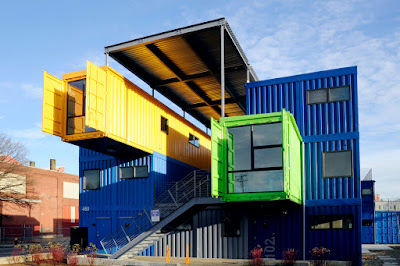
Image by Truth Box, Inc. z
Q. What specific aspects of the building make it green? Are there any other natural or recycled materials incorporated within the building?
A. The building is run only on air to air heat pumps and electric energy. The heating and cooling is provided by an air-2-air device that looks like a typical air conditioner. There is no furnace or boiler involved with the heating. The building has walls made of steal and all the joints are welded together, which helps with keeping the building well sealed from the exterior. The windows are designed to be large enough to bring enough daylight in so the lights can be kept off for most of the day. Yet are a small enough and dispersed in a strategic way to decrease energy loss. There is a 10 kWh solar array on the roof that covers about 10 percent of the energy load. The interior finishes include bamboo, cork, and recycled carpet tiles. The paint used throughout the building is no VOC paint. The indoor air quality is excellent.
Q. What new technology is involved in the series of buildings?
A. When the windows are closed, air is being exchanged in and out and circulated throughout the building with ERV at the rate of about four air changes a day. The air filters have to be changed twice a year.
Q. What kind of cost savings have you seen or hope to achieve for this project?
Image by Truth Box, Inc. z
A. Renters are paying about a third of the typical rate of the energy costs then if they were renting from a conventional office building.
Q. How long did the Box Office property take to build and what went into the project?
A. The project took between 9 and 10 months to build. The shipping containers took four days to erect; 20 percent of the construction was off-site, mostly modifying the shipping containers and installing the windows and doors
Q. Is there anything you would change?
A. I would like to do the next project with more work done off-site if possible. During this project there was more time put. Overall I am very pleased with the work.